Portugal has become one of the most sought-after destinations for international weddings and for good reason. The light, the settings, the food, the sea, the ease of access from most of Europe and the United States: there is a genuine case for it as a place to celebrate.
What makes the difference isn’t the destination. The couples who have the most extraordinary weddings in Portugal are almost always the ones who understood early what the planning process actually requires and prepared accordingly.
The patterns below are the ones that arise most consistently when destination weddings in Portugal are planned from a distance, without local knowledge.
Starting the Process Too Late
Portugal has become one of the most requested destinations for international weddings. The venues and suppliers that couples want most — photographers, caterers, florists with a strong portfolio — are reserved earlier than most couples expect.
Couples who begin the process at what feels like a reasonable lead time often find that their first choices are no longer available. The timeline for a destination wedding in Portugal is not the same as for a wedding at home.
Choosing a Venue Before Understanding What the Proposal Includes
Couples planning a wedding in Portugal from abroad, without the support of a local wedding planner, generally evaluate venues based on photographs and initial proposals.
These proposals are generally based on minimal assumptions, which are not always aligned with the couple’s initial ideas. For example, a catering package may cover only seven hours of service, meaning a celebration that runs until two in the morning will generate costs that were not part of the first figure. VAT is itemised separately and the breakdown is not always immediate to read. Additional licences may apply depending on the location. These details are usually present, in the footnotes, but without knowing what to look for, they are easy to miss.
The gap between an initial quote and the actual investment is almost always discovered later than it should be. At Name It Weddings & Events, venues are visited directly on the couple’s behalf, with the planning brief in hand and a clear understanding of what the full cost structure looks like.

Planning in Your Own Schedule
Couples planning from abroad fit the process around their own working week. By the time they sit down in the evening to make calls or write a brief, most Portuguese suppliers have already finished their day.
During peak season, a Saturday afternoon is not when a florist or a catering team is free for a conversation. It is when they are running someone else’s wedding. Emails wait until Monday. Calls go unanswered until the following week. Decisions that should take a day take several. The wedding date does not wait.
Booking Each Supplier Separately And What Gets Missed
By the time a couple has confirmed the catering team, the florist, the hairdresser and the furniture hire, each contract looks straightforward on its own. It is only when they try to coordinate everything together that the gaps begin to appear. The details and costs that were not foreseen at the initial stage begin to surface.
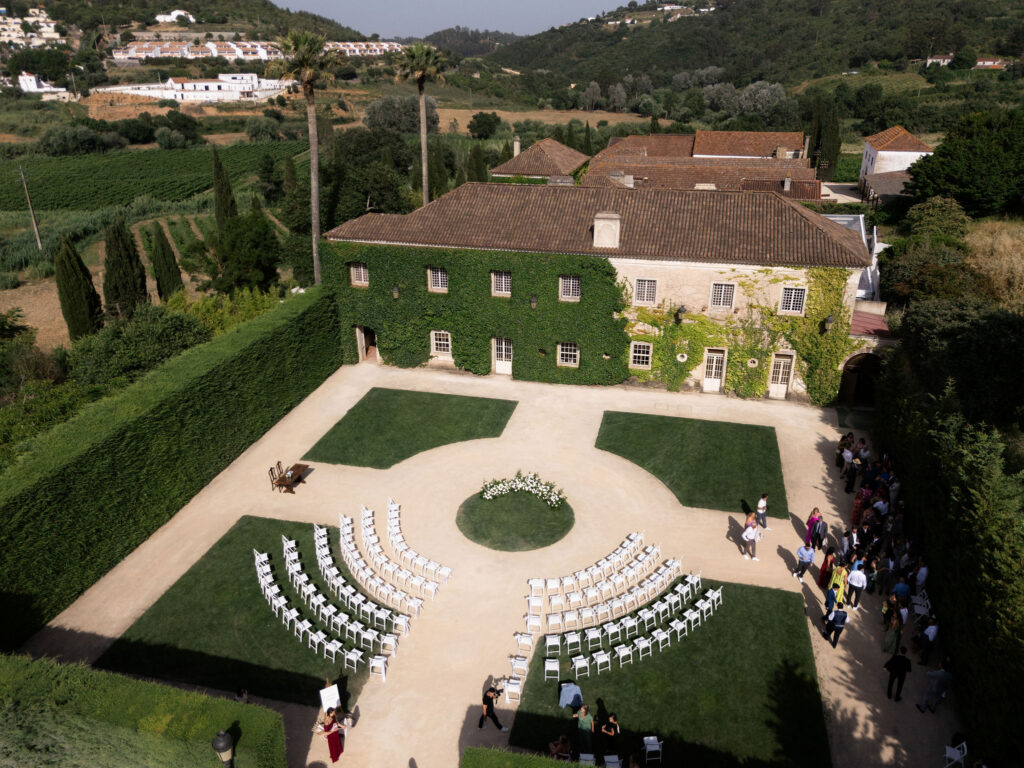
A venue sixty kilometres from Lisbon generates transport costs for the furniture company, the makeup artist, the hairdresser. Some teams need accommodation the night before. Payment schedules across multiple vendors, each with different deadlines, add another layer that accumulates quietly and is rarely anticipated at the start.
Choosing Suppliers Without a Local Reference Point
Portugal has exceptional suppliers across every category: photographers, caterers, florists, musicians. The question is never whether quality exists. It is how to identify the right match for a specific celebration, in a specific setting, at a specific time of year.
A catering team that works beautifully in a city venue may not have the logistics to operate at a rural estate two hours away. The same applies across every supplier category. These are questions of fit and they only become visible through direct knowledge of the market of Lisbon, Sintra, Cascais and the Alentejo.
Pricing is equally difficult to benchmark from a distance. Without a local reference point, there is no way to know whether a figure reflects the standard for what you are looking for.
At Name It Weddings & Events, one of the most consistent observations is how often couples arrive not knowing which questions to ask. The answers only become available through direct experience of working in the region.
Planning the Wedding but Not the Weekend
International guests travel specifically to be present. For many of them, the wedding is not a single afternoon. It is several days in a country they may not know well. The accommodation, the movement between places, the evening before, the first meal together: each of these moments matters more than couples tend to anticipate when they first begin planning.
When planning focuses entirely on the ceremony and dinner, the rest of the experience is assembled last, from whatever is still available. The couple who spent months planning the day can end up spending the day managing it, which is a very different thing from being present in it. The celebrations that guests still talk about months later are rarely the most elaborate. They are the ones where the couple was genuinely present, and where that presence was felt by everyone in the room.
Where to Begin if You Want to Avoid These Mistakes
At Name It Weddings & Events, the first conversation is not about proposals. It is about understanding what a couple is imagining and identifying, early on, where the most significant decisions are likely to arise.
If you are still working out whether a planner makes sense for your celebration, Do You Need a Wedding Planner in Portugal? is a useful place to start. If you have already decided to move forward, the right questions to ask a wedding planner in Portugal is the natural next step.
NOTES
– Main Image Photography: N. K. Studio
– All images featured in this article are from weddings planned and coordinated by NAME IT Weddings & Events